
The four-day joint Naval exercise 'MALABAR 2013' in the Bay of Bengal between the United States and India, providing an opportunity to advance multinational maritime relationship and mutual security issues, began on Thursday.

A painting displayed at the Kochi Biennale has sparked controversy and drawn criticism from Christian groups, who allege that the artwork hurts religious sentiments by presenting a distorted depiction of Christ's Last Supper.
The government has recently turned down Indian Air Force's request to take part in the India-United States bilateral naval exercise Malabar.

While the first phase of the 24th edition of the Malabar exercise was conducted in Bay of Bengal from November 3-6, the second phase was conducted in the Arabian Sea from November 17-20, said a statement by the Indian Navy.

INS Vagir set a new record for the longest-ever deployment of any Scorpene-class submarine, covering a distance of 7,000 kilometres to reach Australia for joint military exercises.

Although the Malabar is a routine exercise which has been carried out for several years now, security experts attach a lot of traction to it in view of China's assertive behaviour in the South China Sea, observes Rup Narayan Das.

95 aircraft, 16 ships and 2 submarines from 3 countries are taking part in Malabar exercise.

The exercise is taking place at a time India and China are locked in a nearly six-month-long bitter border standoff in eastern Ladakh that has significantly strained their ties.

The 19th edition of the Malabar naval exercise saw the Indian, US and Japanese maritime forces participated jointly in the routine.

The high-voltage Malabar exercise featuring the navies of all four Quad countries -- India, the US, Australia and Japan -- began on Thursday off the coast of Guam against the backdrop of a resolve by the four nations to solidify cooperation for a free and open Indo-Pacific in view of China's rouge behaviour in the region.

Indian Admirals say Malabar 2018 will involve unprecedented complexity, featuring enemy threats in all three dimensions, but especially underwater threats from submarines -- a key Chinese strength. For the first time, officers from all three navies will be posted on other navies' warships. That means Indian Navy officers will obtain the unprecedented benefits of operating on US nuclear attack submarines and Japan's highly regarded Soryu submarines.
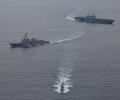
The second phase of the mega exercise is scheduled to be held from November 17 to 20 in the Arabian sea.
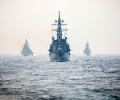
Aircraft carriers of India, the United States, Japan and Australia are set to take part in the second phase of Exercise Malabar that is scheduled to take place from November 17 to 20 in the Indian Ocean region, the Navy said on Monday.
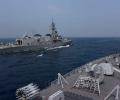
The navies of India, the US, Japan and Australia on Tuesday held a series of complex manoeuvres in the Bay of Bengal, kick-starting the four-day-long first phase of the Malabar naval exercise, seen as a prelude to future military cooperation among the member nations of the Quad or Quadrilateral Coalition.

Malabar 2016 -- a trilateral maritime exercise involving the Indian Navy, the Japan Maritime Self-Defense Force and the US naval forces in the Indo-Asia-Pacific -- concluded on June 17.
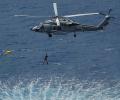
India, Japan and the Unoted States on Friday kicked off their marine war games, Malabar Exercise, close to the South China Sea as they focus on deeper military ties and greater interoperability amid rising tensions in the region.
Ahead of the Indo-US military exercise 'Malabar' in the Bay of Bengal from April 9, guided-missile cruiser USS Bunker Hill, one of the vessels in the seventh fleet of the United States Navy, docked at Chennai port on Saturday.
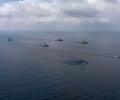
The mega exercise took place at a time India and China are locked in a nearly six-month-long bitter border standoff in eastern Ladakh.

Last year, Chinese media sharply criticised the Malabar exercises.

When a Chinese warship entered Japanese waters, the Indian commander called on China to maintain discipline at sea. Dr Rajaram Panda explains the significance of the Malabar exercises between India, Japan and the US.

India's decision to heed to Australia's request to be part of the mega naval drill comes in the midst of growing strain in ties with China over the border row in eastern Ladakh.
India, Japan and the US are set to focus on "anti-submarine warfare" by deploying "different machines" during the next round of their marine wargames named the Malabar Exercise, amidst increasing presence of Chinese underwater vessels in the strategic Indian Ocean region.

'If the authorities go about completing this project the way they have proposed, this is going to cause a HUGE environmental impact not only on Malabar Hill but also on the rest of the city.'

'India is a top-tier security partner for Australia and we continue to prioritise practical and tangible cooperation that directly contributes to Indo-Pacific stability.'
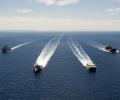
In the lead up to this week Indo-US Strategic Dialogue, for which United States Secretary of State, John Kerry, will be coming to Delhi, the Indo-US defence engagement is even more intense than usual.

The Indian Army has built infrastructure to house 450 tanks and over 22,000 troops in the Eastern Ladakh sector.
China said that military cooperation should be "conducive" to regional peace and stability.
The first phase of the Malabar exercises is due to begin in the Bay of Bengal off Visakhapatnam coast on Tuesday and end on November 6. The second phase of the mega exercise is scheduled to be held from November 17 to 20 in the Arabian sea.

The Chinese navy's growing aggression in the Western Pacific is bringing together a range of allies.

The next edition of the high-voltage Malabar naval exercise begins from August 26 to 29 off the coast of Guam amid mounting global concerns over China's growing military muscle-flexing in the Indo-Pacific region.

Suryakumar Yadav casts vote during Maharashtra Assembly polls

The coming together of the Quad and the Australia-UK-US grouping would be a formidable adversary, moving toward the creation of a 'thousand ship navy' that reins in the PLA navy in the Indo-Pacific.
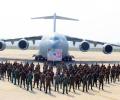
Dharma Guardian 2025 will primarily focus on urban warfare tactics and counter-terrorism operations and underscores the growing strategic partnership between India and Japan.
Malabar 2011 is the latest in a continuing series of exercises conducted to advance multinational maritime relationships and mutual security issues.
'Cooperation at sea involves not just ships going out together and carrying out exercises over a couple of days, but understanding the whys and the wherefores,' points out Vice Admiral Premvir Das (retd).
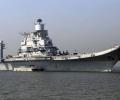
A number of other frontline ships, submarines and fighter jets of the three countries will be part of the over week-long drill in the Bay of Bengal which is taking place in the backdrop of a major military face-off between armies of India and China in the Sikkim section.

The navies of the three countries undertook the exercise in rough seas and under challenging weather conditions.

In a year bookended by intractable conflicts and geopolitical fragmentation, India focused on ramping up military prowess by broadly firming up defence procurement worth Rs 4.22 lakh crore even as Indian and Chinese militaries completed pulling back their troops from border face-off points in eastern Ladakh.
 © 2026 Rediff.com - Advertise with us - Disclaimer - Privacy Policy - Sitemap - Feedback - About us - Terms of use - Grievances